

A seven-year-old girl sits in the back of her family’s car in a Phoenix parking lot. While other kids her age are dreaming, she’s awake, listening to the sounds of the street, her small body tense with a quiet, constant hum of anxiety. She isn’t just tired or sad; her brain, in its most critical period of growth, is being actively rewired by the trauma of having no stable place to call home. This isn’t a rare story. For thousands of children in Arizona, the constant uncertainty of homelessness has a profound, physical impact on their developing brain, affecting everything from memory and learning to their ability to manage emotions for years to come.
This is not just a social crisis; it’s a neurological one unfolding in our communities. At Help Now AZ, we witness the effects of this trauma daily. Our work is not just about providing aid; it’s about creating the stability and support necessary to protect a child’s developing brain and give them a chance to heal, learn, and thrive.
The Neurological Cost of Instability: Understanding Toxic Stress
A child’s first few years are a time of explosive brain growth, with over one million new neural connections forming every second. This intricate process relies on a foundation of safety, predictability, and nurturing care. When a child’s world is defined by the chaos of homelessness, their brain is forced to shift from a state of learning and growth into one of pure survival.
This prolonged activation of the stress response system leads to a condition known as toxic stress. It is worlds away from the healthy stress of mastering a new skill. For a child experiencing homelessness, toxic stress is a relentless companion triggered by:
- Constant Uncertainty: Not knowing where they will sleep, where their next meal will come from, or if their family will be safe. This insecurity is often deepened by poor nutrition, an issue you can learn more about in our guide on how family homelessness and child hunger are connected in our detailed guide.
- Disrupted Routines: Without a consistent schedule for sleep, meals, and play, the brain cannot develop the healthy, predictable patterns it needs to regulate itself.
- Exposure to Unsafe Environments: Living in cars, overcrowded shelters, or on the streets keeps a child’s “threat detection” system permanently activated.
Think of a child’s brain as a house under construction. Toxic stress is like a constant earthquake, shaking the foundation and weakening the entire structure before it’s even finished.
This relentless stress floods a child’s developing brain with cortisol, a hormone that becomes corrosive in high doses. It disrupts the formation of vital neural pathways, especially in the parts of the brain responsible for focus, planning, and emotional control—known as executive functions. At Help Now AZ, our programs aim to create moments of stability that act as a crucial buffer against this toxic stress, giving a child’s brain the chance to rest, reset, and build the resilient foundation they need.
How Toxic Stress Rewires a Child’s Brain for Survival
Why does instability leave such a deep and lasting mark on a child? The simplest way to understand the impact of homelessness is to see a young brain as a house being built. Every day, the blueprint gets more complex as new rooms are framed and wiring is installed. Toxic stress is the constant, low-grade earthquake rattling the entire construction site, disrupting the brain’s delicate architecture as it’s being built.
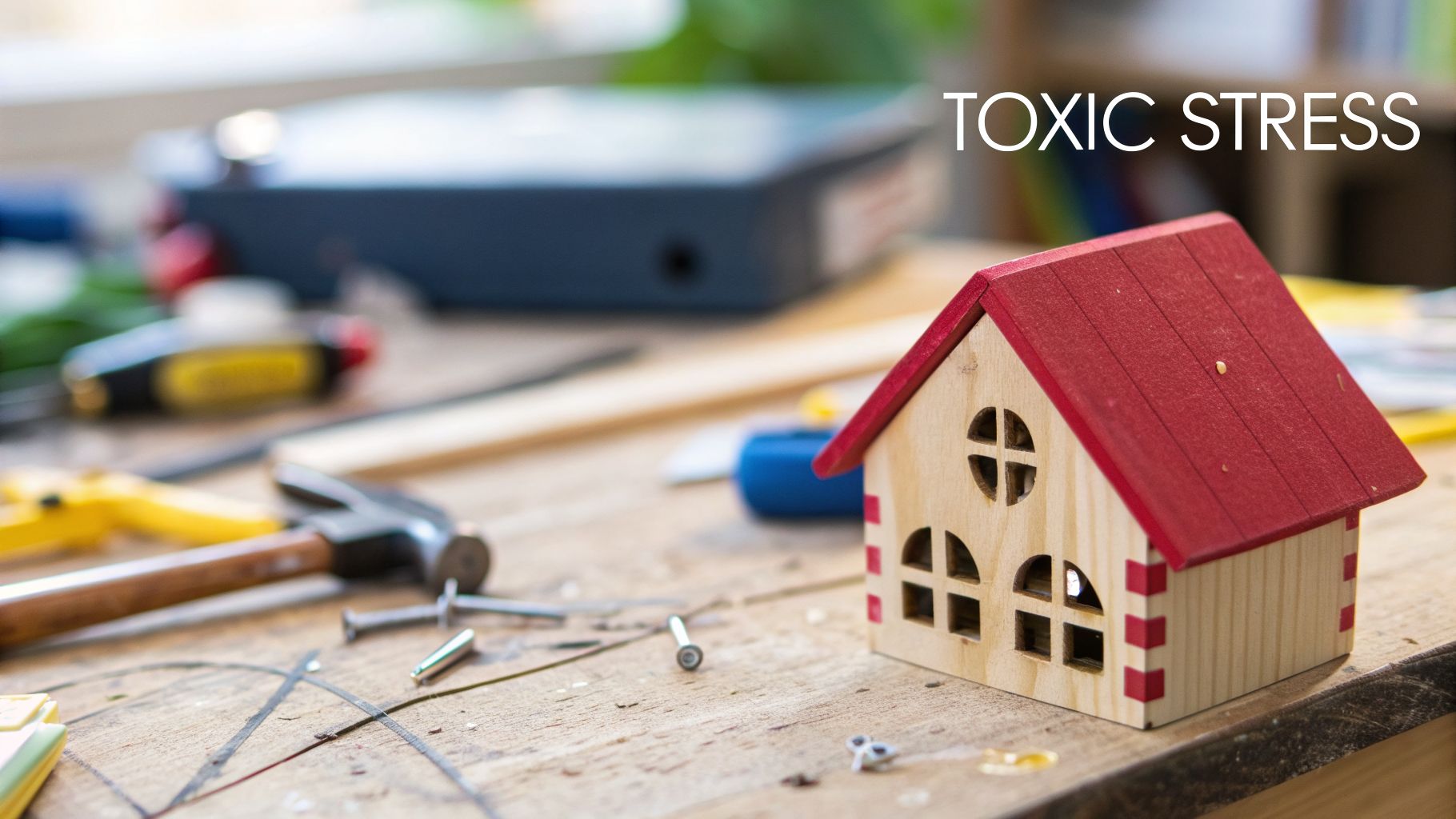
This isn’t just a metaphor—it’s biology. The brain’s stress response is meant for short bursts of “fight or flight.” When it’s stuck in the “on” position, it floods the body with the hormone cortisol. For a developing brain, chronically high levels of cortisol are corrosive, literally interfering with how brain cells connect and communicate.
A Brain Forced to Prioritize Survival Over Growth
Toxic stress forces the brain to divert its limited resources to immediate survival, putting long-term development on hold. This rewiring leads to significant changes in three key areas:
- The Prefrontal Cortex (The “CEO”): As the brain’s command center for focus, planning, and impulse control, its development is weakened by toxic stress. This makes it incredibly hard for a child to concentrate in class, think through problems, or manage their reactions.
- The Hippocampus (The “Librarian”): Essential for learning and memory, this area can actually shrink under high cortisol levels. It becomes difficult for a child to store and retrieve new information, like trying to learn with a librarian who can’t file away any new books.
- The Amygdala (The “Alarm System”): This is the brain’s threat-detection center. Under toxic stress, it becomes overactive and hypersensitive, leaving a child stuck in a state of high alert, constantly scanning for dangers that may not exist.
It’s critical to understand that these neurological changes are not a reflection of a child’s character or potential. The challenges we see—inattention, emotional outbursts, or learning struggles—are the brain’s survival mechanisms in action.
For children in Arizona, the statistics are a stark reminder of this reality. Research shows that young children experiencing homelessness face higher rates of developmental delays and emotional problems. This isn’t a moral failing; it’s a biological response to an impossible situation. We explore this connection further in our guide to mental health and homelessness in Phoenix. By understanding what’s happening beneath the surface, we can move from judgment to compassionate, science-backed support.
From Brain Science to Classroom Struggles: A Teacher’s View
The neurological impact of toxic stress isn’t confined to a lab; it shows up every single day in classrooms across Arizona. When a child’s brain is constantly in survival mode, the very skills needed for school success—paying attention, remembering facts, and collaborating with peers—get pushed aside. Understanding this connection is the first step toward offering real, compassionate help.
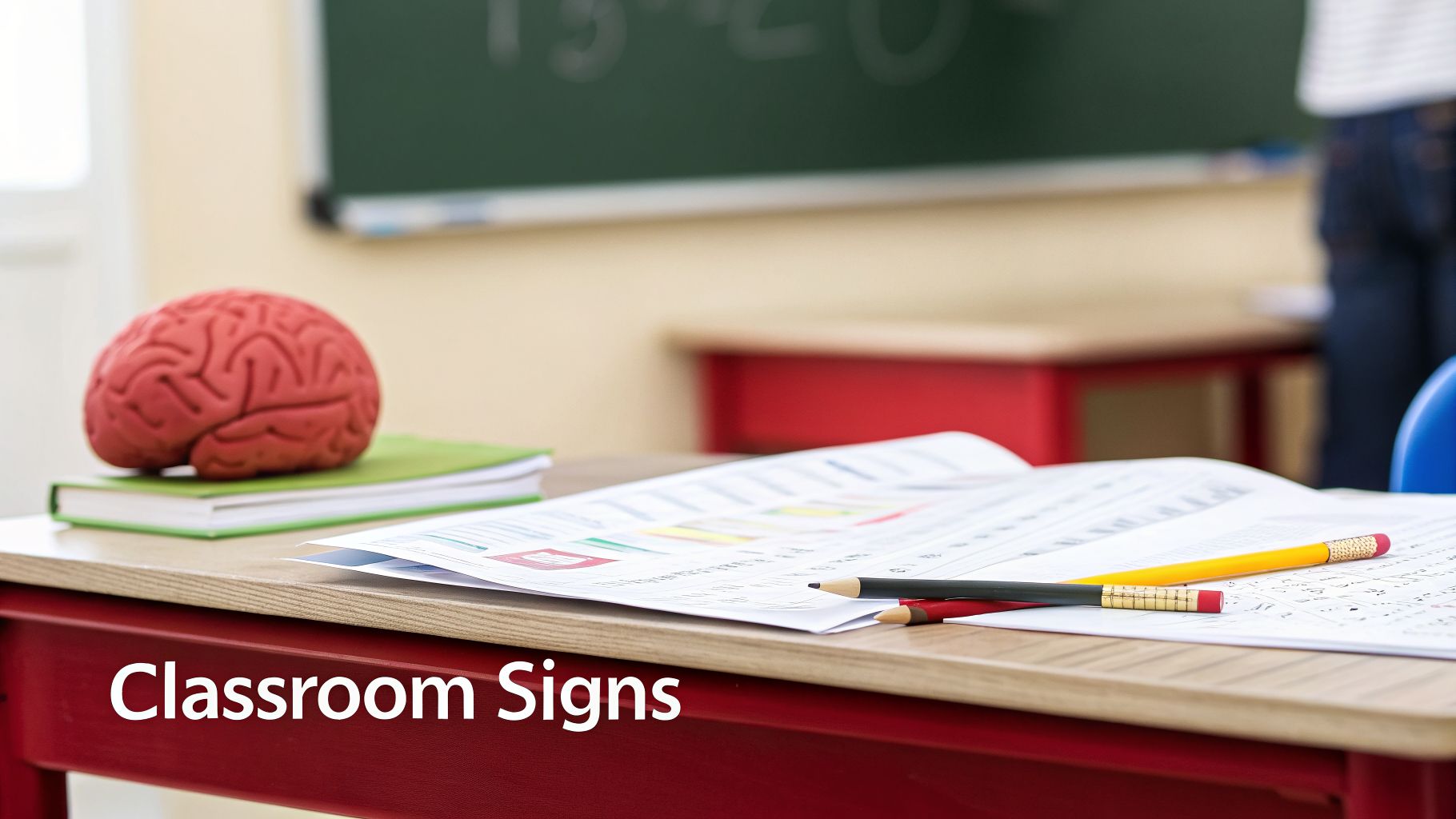
The behaviors we often see are direct symptoms of a brain under siege. They are not reflections of a child’s character, intelligence, or desire to learn, but a logical, biological response to an environment that feels unsafe and unpredictable.
Connecting Brain Signals to School Challenges
When the brain’s “CEO” (prefrontal cortex) is offline, its “librarian” (hippocampus) is swamped, and its “alarm system” (amygdala) is on high alert, thriving in a structured school setting becomes nearly impossible.
| Area of Impact | Neurological Root (Simplified) | Observable Classroom Behaviors |
|---|---|---|
| Cognitive Function | Weakened Prefrontal Cortex: The brain’s control center is struggling with focus, planning, and self-control. | • Difficulty concentrating or following multi-step directions. • Trouble remembering information, even from the day before. • Appears “zoned out,” distracted, or disengaged. |
| Emotional Regulation | Overactive Amygdala: The brain’s threat detector is on high alert, perceiving danger even in safe situations. | • Sudden emotional outbursts (anger, crying) that seem disproportionate to the trigger. • High levels of anxiety, jumpiness, or constant worry. • Difficulty trusting teachers or forming friendships. |
| Social Skills | Disrupted Social Pathways: The brain is wired for self-preservation, not social connection. | • Withdraws from group activities or struggles with cooperative play. • Misreads social cues, leading to conflicts with classmates. • May seem overly aggressive or intensely shy. |
| Academic Performance | Overloaded Hippocampus: The brain’s memory center is too busy processing stress to store new learning effectively. | • Falling behind in core skills like reading and math. • Unable to complete homework or manage long-term projects. • Struggles to grasp abstract concepts or apply new knowledge. |
These behaviors are adaptations for survival in a chaotic world. The classroom must become the one place where that child’s brain can finally feel safe enough to switch from surviving to learning.
This change in perspective is vital. Instead of asking, “What is wrong with this child?” we must start asking, “What has happened to this child, and how can we help?” This simple question moves us from managing behavior to nurturing the whole child. Implementing trauma-informed teaching practices is a powerful way to create this nurturing environment. By providing consistency, predictability, and unwavering support, like ensuring a child has necessary school supplies through our Back to School Tools program, we create a sanctuary where their brain can begin to heal.
How Stability and Support Can Heal a Child’s Brain
Learning how homelessness impacts a child’s brain can feel disheartening, but there is incredible reason for hope. A child’s brain is remarkably resilient and has a powerful capacity to heal. Just as toxic stress can weaken its foundation, a safe and caring environment can rebuild it, one positive experience at a time. This is the core belief behind Help Now AZ’s programs—they are practical, evidence-based tools designed to directly counteract the effects of toxic stress.
Building Resilience One Step at a Time
Healing begins by meeting a child’s most fundamental needs, which sends a powerful message of safety to their brain.
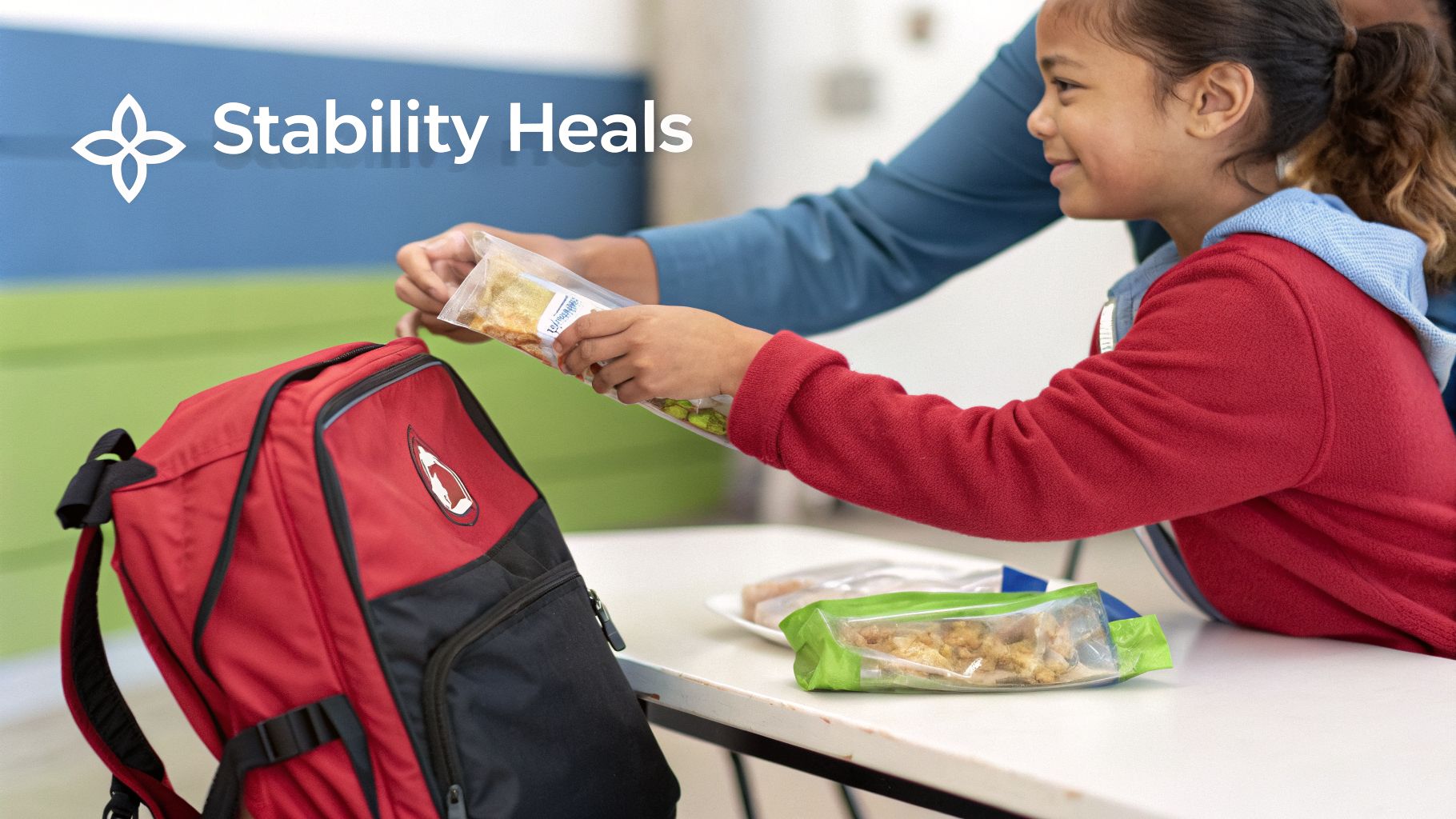
- Consistent Nutrition: A hungry brain cannot learn. Our H.E.L.P. Snackz program does more than fill an empty stomach; it provides the reliable fuel a developing brain needs to function. A simple, predictable snack from a caring adult also releases calming neurochemicals like oxytocin, building trust and proving the world can be a safe place.
- Reducing Daily Stressors: The shame and anxiety of not having a pencil or a backpack can consume a child’s mental energy. Our Back to School Tools program eliminates that stressor. When we hand a child a new backpack full of supplies, we give them back their focus, freeing up their prefrontal cortex to concentrate on lessons, not on what they lack.
- The Power of a Stable Home: Above all, stability is the most powerful antidote to toxic stress. Knowing they have a safe place to sleep allows a child’s brain to move from surviving to growing. This is why services like emergency rent assistance are not just about housing—they are a direct investment in a child’s neurological health. Research consistently shows that stable housing is the single most important factor for healthy childhood development. You can read the full research on how housing instability affects early childhood outcomes.
Your support for these programs creates real, positive change. Every snack packed, every backpack filled, and every donation made helps build a more stable, nurturing world where an Arizona child’s brain can not just survive, but truly thrive. Empowering parents with tools for managing anxiety in children is another key part of this healing journey, giving families the ability to create calm amidst chaos.
Your Role in Building a Resilient Future for Arizona’s Children
The same science that shows how vulnerable a young brain is to stress also reveals its remarkable responsiveness to stability, care, and support. This is where our community becomes the most powerful part of the solution. Every act of support, no matter how small it seems, helps build the nurturing world a child’s brain needs to shift from surviving to thriving.
Here are tangible ways you can help create the consistency and safety a healing brain desperately needs:
- Volunteer Your Time: A positive, consistent interaction with a caring adult can counteract the chaos of homelessness. When a child sees a friendly face at a Help Now AZ event, it reinforces a sense of safety and belonging, releasing calming neurochemicals that build resilience.
- Sponsor Our Programs: Corporate partnerships that fund initiatives like H.E.L.P. Snackz directly reduce daily stressors. When a parent doesn’t have to worry about snacks or school supplies, it lowers stress in the household, which is critical for a child’s healthy development.
- Make a Tax-Deductible Donation: Financial contributions fund the very interventions that allow a child’s brain to heal. Your donation translates directly into consistent meals, essential supplies, and support systems that shield children from the neurological damage of toxic stress. There are many ways to give, from direct donations to creative nonprofit fundraising event ideas.
Your involvement is so much more than charity; it’s a direct investment in a child’s neurological health. You are helping to build the safe, predictable world their brain needs to form healthy connections for learning, emotional regulation, and future success.
The Arizona Charitable Tax Credit: A Powerful Tool for Change
For Arizona residents, there is an especially powerful way to help. The Arizona Charitable Tax Credit allows you to redirect your state tax liability to a Qualifying Charitable Organization (QCO) like Help Now AZ (our QCO code is 20944). This is a dollar-for-dollar credit that costs you nothing extra but provides the critical, consistent funding we need to create stability for children right here in our community.
Frequently Asked Questions
Understanding the complex link between homelessness and a child’s brain development can bring up many questions. Here are compassionate, clear answers to some of the most common ones we hear.
How does homelessness affect children’s mental health?
The constant stress, fear, and instability of homelessness can have a severe impact on a child’s mental health. This often leads to high rates of anxiety, depression, and trauma-related disorders. The brain’s overactive “alarm system” can make a child feel constantly on edge, leading to emotional and behavioral struggles that are a direct response to their unsafe environment.
What volunteer opportunities help homeless children in Arizona?
You can make a direct impact by volunteering with organizations like Help Now AZ. Opportunities often include assembling “H.E.L.P. Snackz” bags, packing backpacks for our “Back to School Tools” program, or assisting at community distribution events. These actions provide tangible resources while also offering the positive, stable adult interaction that is so crucial for a child’s sense of safety and well-being.
Why is early intervention so important for homeless children?
A child’s brain develops most rapidly in the first few years of life, making this a critical window of opportunity. Early intervention can buffer a child from the most damaging effects of toxic stress, helping to build a strong foundation for future learning and health. By providing stability, nutrition, and support as early as possible, we can help ensure a child’s brain develops in a healthy way, giving them a much better chance at long-term success.
How do funding cuts impact homelessness services for children?
Funding cuts directly threaten the stability and resources that are essential for a child’s healthy brain development. When services that provide food, shelter, and school supplies are reduced, the stress on families increases, which in turn elevates the toxic stress a child experiences. Consistent funding through community donations and programs like the Arizona Charitable Tax Credit is vital to maintaining the safety net these children desperately need to thrive.
If you or someone you know needs help—or if you’d like to support homeless children and families in Arizona—contact Help Now AZ. Call 602-341-3822, email [email protected], or visit helpnowaz.org to learn more, volunteer, or make a donation.